
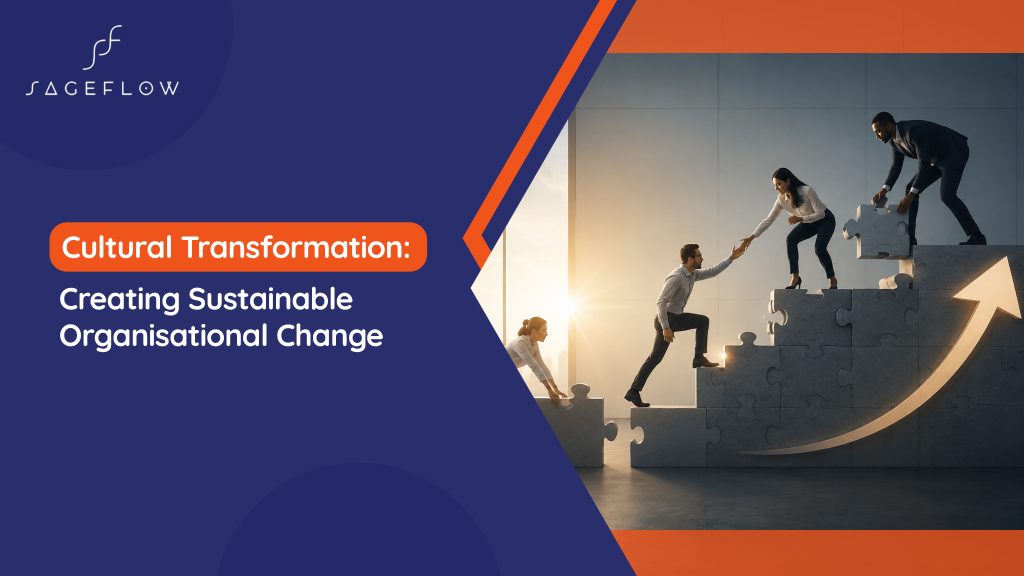
Every organisation has a culture. The question for boards and executive teams is whether that culture is deliberately shaping the organisation’s future or quietly holding it back.
Markets change, customer expectations shift, and strategic priorities evolve. Yet many organisations expect new strategies to deliver different outcomes while leadership behaviours, everyday decisions, and organisational norms remain unchanged.
This gap becomes particularly visible during moments of significant change: an acquisition or merger, a new CEO or leadership transition, rapid growth, a strategic reset, or a major transformation. It can also emerge during a culture or performance crisis, when behaviours that once seemed manageable begin to undermine execution.
Lasting transformation rarely happens under these conditions. Leaders must treat culture as part of strategy rather than as a separate initiative. This places cultural transformation firmly within the responsibilities of organisational leadership.
Boards set strategic direction, while executive teams translate that direction into action. Together, they shape the environment in which decisions are made, accountability is reinforced, and people respond to change.
For this reason, cultural transformation in organisations has become a strategic priority for long-term performance.
Why Cultural Transformation is Fundamental to Sustainable Organisational Change?
Culture is one of the few organisational assets that influences every strategic decision without appearing on a balance sheet.
Boards may approve strategy, executive teams may define priorities, and leaders may allocate resources, but culture ultimately determines how consistently those decisions are interpreted and acted upon across the organisation.
From a governance perspective, cultural transformation is the deliberate process of aligning leadership behaviours, organisational systems, decision-making, and accountability with strategic direction. It does not sit alongside business transformation. It helps determine whether transformation can succeed and endure.
Many organisations approach transformation by introducing new operating models, technologies, or performance measures. These changes can improve capability, but they rarely produce lasting results if the culture continues to reward outdated behaviours or conflicting priorities.
Sustainable transformation requires leaders to reshape the environment in which people make decisions, collaborate, respond to change, and deliver organisational outcomes.
This is where culture and change management intersect. Change management focuses on implementing specific initiatives, while cultural transformation strengthens the organisational conditions that allow those initiatives to become part of everyday practice.
One supports the delivery of change; the other helps prevent the organisation from reverting to previous ways of working once the initiative ends.
Effective cultural transformation in organisational development also requires boards and executive teams to establish clear expectations for the behaviours and leadership standards that support long-term performance. Governance systems, organisational processes, and leadership decisions must then consistently reinforce those expectations.
When approached strategically, cultural transformation becomes an organisational capability rather than a temporary programme. It enables leaders to build an organisation that can adapt to changing priorities, strengthen execution, and sustain performance without losing alignment among its purpose, strategy, and how people work together.
Signs Your Organisation Needs a Cultural Transformation
Culture rarely weakens overnight. More often than not, it drifts away from the organisation’s strategic direction over time. Boards and executive teams may continue to make sound decisions, yet the outcomes become increasingly inconsistent because the behaviours, leadership practices, and organisational norms no longer reinforce those decisions.
Recognising these signals early allows leaders to address underlying issues before they begin to affect performance, resilience, and long-term growth.
Strategy and execution are no longer aligned
One of the earliest indicators is a growing gap between strategic intent and operational reality. The organisation has a clear direction, but priorities become diluted as they move through different levels of leadership. Teams interpret objectives differently, accountability becomes inconsistent, and strategic initiatives lose momentum.
When this pattern persists, the issue often extends beyond execution. It signals the hidden cost of cultural misalignment, which no longer supports the behaviours required to achieve its strategic goals.
Leadership messages lack consistency
People take their cues from leadership long before they respond to formal policies or frameworks. When senior leaders communicate different priorities, make conflicting decisions, or model behaviours that contradict stated values, uncertainty spreads quickly.
This is particularly significant during a new CEO transition, strategic reset, M&A, or major transformation, when employees look to leadership for clarity about what is changing and what should remain consistent.
Successful organisational culture change therefore starts with visible leadership alignment. Without it, even well-designed transformation efforts struggle to gain credibility.
People resist change despite strong planning
Resistance does not always mean that people oppose change. It can reflect uncertainty about expectations, inconsistent leadership, or a lack of confidence that new ways of working will last.
This is where culture in change management becomes important. Transformation is more likely to succeed when organisational systems, leadership behaviours, and decision-making reinforce the change rather than relying solely on communication and project plans.
Decision-making becomes reactive rather than purposeful
Under sustained pressure, organisations can begin prioritising immediate problems over long-term objectives. Leaders spend more time resolving operational issues, while strategic priorities receive less attention.
Over time, this weakens collaboration, reduces organisational agility, and makes it harder to maintain momentum through periods of growth, disruption, or transformation.
Trust and accountability begin to erode
Healthy organisational cultures encourage constructive challenge, shared accountability, and informed decision-making. When these qualities begin to diminish, leaders may notice slower decisions, reduced collaboration, and a growing reluctance to take ownership of outcomes.
These behaviours rarely emerge in isolation. They often indicate that the organisation’s culture no longer supports the level of trust and accountability needed to execute strategy effectively.
Benefits of Sustainable Organisational Change
The success of organisational change is not measured by how quickly a transformation programme is delivered. It is measured by whether the organisation continues to make better decisions, adapt to new challenges, and achieve stronger outcomes after the initiative has ended.
That is the difference between implementing change and embedding it. When boards and executive teams invest in sustainable change, they strengthen the organisation’s ability to execute strategy, respond to disruption, and maintain performance as priorities evolve.
Stronger strategic execution
Even the most ambitious strategies depend on consistent execution. When leadership behaviours, organisational priorities, and board decisions are aligned, strategic objectives are less likely to lose momentum as they move through the organisation.
Strong board and executive alignment reduces competing priorities, strengthens accountability, and helps leaders maintain focus on long-term outcomes.
Greater organisational resilience
Organisations that embrace culture transformation are better positioned to navigate uncertainty without losing strategic direction.
They develop the leadership capability and organisational discipline to adapt to market shifts, restructuring, rapid growth, or leadership transitions while remaining focused on long-term objectives.
This becomes particularly valuable when organisations face significant disruption or need to change direction quickly.
More effective leadership and decision-making
Sustainable change creates greater consistency in how leaders make decisions, communicate priorities, and hold themselves accountable.
When leadership teams operate with shared expectations, they reduce uncertainty and build greater confidence across the organisation. Decisions become more closely connected to strategic priorities rather than competing functional interests or short-term pressures.
A culture that supports continuous improvement
Transformation loses value when progress depends on a temporary programme. Sustainable culture change helps make learning, collaboration, and continuous improvement part of everyday operations.
This allows organisations to strengthen their capabilities over time rather than repeatedly starting again whenever new priorities emerge.
Greater confidence during future change
No organisation remains static. New technologies, evolving customer expectations, regulatory changes, and shifting market conditions will continue to reshape how organisations operate.
Boards that invest in changing organisational culture create stronger foundations for future transformation. Clearer decision-making, shared expectations, and a stronger understanding of why change matters help the organisation respond without losing strategic focus.
Key Elements of a Successful Cultural Transformation
Sustainable cultural transformation depends on a set of conditions that shape how the organisation is governed, how leaders behave, and how people are held accountable.
These conditions provide the foundation for embedding change rather than treating it as a temporary programme.
When they work together, culture becomes a strategic asset that supports execution, adaptability, and long-term organisational performance.
Leadership alignment around a shared direction
Transformation requires leaders to agree on the direction of travel and demonstrate that alignment through their decisions. Different functions may have different priorities, but the executive team must consistently reinforce shared expectations and organisational values.
This alignment becomes especially important during M&A, leadership transitions, strategic resets, and periods of rapid growth, when competing priorities can quickly create confusion.
Governance that reinforces strategic priorities
One of the crucial responsibilities of a board is to consider whether culture supports the organisation’s strategic objectives. Boards should challenge whether leadership decisions, organisational systems, and accountability measures reinforce the behaviours required for future success.
Effective governance keeps culture connected to strategy and ensures that responsibility for transformation does not rest solely with individual leaders or temporary programmes.
Systems and processes that support new behaviours
Leadership can establish expectations, but organisational systems determine whether those expectations become part of everyday practice. Performance measures, decision-making processes, recognition, and accountability frameworks should reinforce the behaviours the organisation needs.
If these systems continue to reward outdated behaviours, they can undermine even strong leadership commitments to cultural transformation.
Accountability at every level
Transformation gains credibility when leaders and teams are accountable for both outcomes and behaviours. Senior leaders must model the standards they expect from others and address inconsistencies when they arise.
This creates greater consistency between what the organisation says it values and what it reinforces through leadership and governance practices.
Continuous learning and adaptation
Cultural transformation must remain responsive as organisational priorities and external conditions change. Boards and executive teams should create opportunities to evaluate progress, listen to feedback, and adjust their approach without losing sight of strategic objectives.
Ongoing learning also helps prevent transformation from becoming a one-off intervention. It keeps the organisation capable of adapting as new challenges and opportunities emerge.
Steps to Create Cultural Transformation
Cultural transformation cannot be delegated to a single function. It requires sustained leadership, disciplined governance, and a willingness to challenge the organisational habits that no longer support future success.
While every organisation’s journey is different, leaders can follow a deliberate process to turn strategic intent into lasting organisational change.
1. Establish a clear strategic case for change
Transformation begins with a shared understanding of why change is necessary. Boards and executive teams should connect the case for change to the organisation’s strategy, market environment, and long-term objectives.
This means explaining why existing leadership behaviours, decision-making practices, or ways of working may no longer support the organisation’s direction. A clear strategic case gives people a reason to change rather than simply a list of new expectations to follow.
2. Assess the current organisational culture
Before defining the future state, leaders need an honest view of the organisation’s current culture. This includes examining behaviours, leadership practices, governance processes, and systems that either support or constrain strategic execution.
Assessment should go beyond employee surveys. Leaders should consider how decisions are made, how accountability works, how teams collaborate, and where existing norms create barriers to performance.
3. Define the behaviours that support future success
A successful transformation needs more than a set of organisational values. Leaders should identify the specific behaviours and leadership practices that will help the strategy succeed.
These expectations should be practical and observable. When leaders consistently model and reinforce them, employees can see how strategic priorities translate into everyday decisions and actions.
4. Align systems, processes, and leadership decisions
Culture changes when organisational systems reinforce the behaviours leaders expect. Performance management, decision-making, recognition, governance, and operational processes should all support the desired direction.
This is where culture in change management becomes important. Sustainable transformation depends on creating organisational conditions that support new ways of working rather than allowing established systems to pull people back towards familiar patterns.
5. Build leadership capability and accountability
Leaders have the greatest influence over whether cultural transformation gains credibility. Their decisions, communication, and daily behaviour show the organisation what truly matters.
Leadership development should therefore equip leaders to model expected behaviours, make consistent decisions, encourage constructive challenge, and take responsibility for sustaining change.
Accountability must extend beyond delivering transformation milestones to maintaining the behaviours that make change durable.
6. Measure, reinforce, and adapt
Cultural transformation does not end when implementation milestones are reached. Boards and executive teams should regularly assess whether desired behaviours are becoming embedded and whether culture continues to support strategic priorities.
They should use what they learn to reinforce progress and adjust their approach as circumstances change. Treating transformation as an ongoing leadership responsibility helps organisations sustain strategic alignment and remain adaptable over time.
Challenges During Cultural Transformation
Cultural transformation can lose momentum when leadership attention shifts, organisational systems reinforce old behaviours, or competing priorities take precedence.
For boards and executive teams, recognising these risks early helps sustain progress rather than repeatedly restarting transformation efforts.
Inconsistent leadership commitment
Transformation depends on consistent leadership behaviour. If executives communicate one set of priorities but make decisions that reinforce old ways of working, confidence in the transformation quickly erodes.
This risk becomes particularly acute during leadership transitions, strategic resets, or periods of significant organisational change. Visible and consistent leadership alignment helps maintain credibility throughout the transformation.
Existing systems continue to reward old behaviours
Organisations can introduce new expectations without changing the systems that influence everyday decisions. Performance measures, governance processes, incentives, and operational practices may continue to reward behaviours that no longer support strategic priorities.
When this happens, employees receive conflicting signals about what success looks like. Cultural transformation becomes difficult to sustain unless organisational systems evolve alongside the desired behaviours.
Change fatigue reduces organisational commitment
Cultural transformation rarely happens in isolation. Organisations may be managing digital programmes, restructures, M&A activity, process changes, or shifting market pressures at the same time.
When too many priorities compete for attention, people can become overwhelmed and disengaged. Leaders can reduce this risk by establishing clear priorities, explaining the purpose behind change, and allowing sufficient time for new ways of working to become embedded.
Resistance is misunderstood
Resistance is not always opposition to change. It can reflect uncertainty, mixed messages, a lack of trust, or concerns about whether leaders will sustain their commitment.
Rather than treating resistance as a behavioural problem, leaders should examine the organisational conditions behind it. Understanding those conditions creates opportunities for dialogue, strengthens trust, and helps build genuine ownership of new ways of working.
Momentum declines once implementation ends
Transformation is not complete when key milestones have been achieved. Without continued reinforcement, organisations can gradually return to familiar behaviours, particularly when new pressures emerge.
Sustaining cultural transformation in the workplace requires ongoing leadership attention, regular evaluation, and governance practices that keep culture connected to evolving strategic priorities.
Building the Conditions for Sustainable Transformation
Sustainable cultural transformation is rarely achieved through isolated initiatives. It develops when leadership, governance, and organisational practices consistently reinforce the direction the organisation has chosen to pursue.
That is where SageFlow works with boards and executive teams to strengthen the connection between culture, leadership, and strategy, helping organisations create the conditions for lasting change rather than treating transformation as a short-term programme.
This perspective becomes particularly valuable when organisations face moments that test existing culture and leadership alignment, such as M&A, a new CEO or leadership transition, rapid growth, a strategic reset, or a major transformation. In these situations, cultural transformation can determine whether strategic change gains momentum or becomes constrained by established behaviours and ways of working.
Ultimately, cultural transformation in organisations is not simply about responding to today’s challenges. It is about building an organisation that can continue to adapt, execute its strategy with confidence, and sustain performance as priorities evolve.
For leaders seeking to strengthen that capability, SageFlow provides the strategic perspective and practical guidance needed to turn cultural transformation into lasting organisational value.