
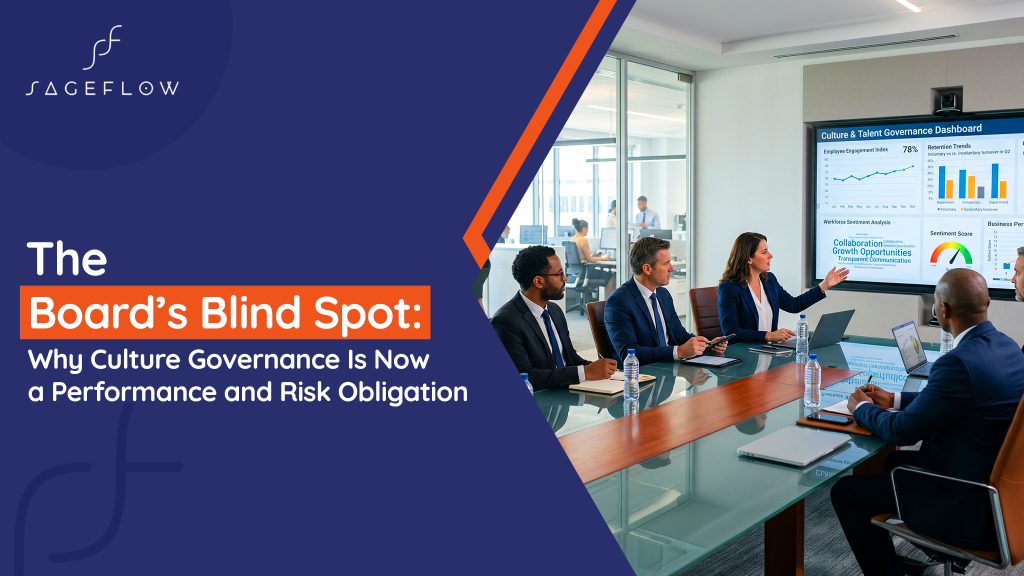
Boards of most companies govern culture the same way they once governed financial risks through management-prepared reports. However, such an approach is becoming difficult to defend.
Culture is no longer a soft organisational issue that sits adjacent to performance. It is now directly connected to leadership alignment, strategic stability, execution capability, and organisational risk.
Boards that recognise the connection can govern culture with greater rigour. In times of growth, leadership transition, restructuring, or operational pressure, culture plays a critical role in organisational performance. It shapes an organisation’s ability to execute strategy, respond to uncertainty, and retain capability.
It also helps sustain trust across teams and leadership levels. However, many organisations still treat cultural performance as secondary human resources (HR) rather than a governance responsibility.
It creates a critical blind spot. One reason this blind spot still exists is that the organisations often focus on workforce outcomes rather than the organisational conditions that shape them.
Turnover reports and exit interviews explain employees’ already-made decisions. But it doesn’t reveal the cultural conditions that encourage long-term commitment.
This blog explores why cultural governance has become a critical performance and risk obligation. It also explores how organisational misalignment affects leadership effectiveness and strategic execution, as well as the role boards and leaders play in strengthening long-term organisational performance.
The Real Risk Is Not Attrition – It Is Organisational Misalignment
Most organisations attempt to understand culture through lagging indicators. These indicators are employee turnover, engagement surveys, and exit interviews.
Though these measures provide useful signals, they only describe the causes of resignation. The survey and exit interview findings highlight the decisions employees have already made.
It is a reactive approach and works when the issues become operationally visible. However, the deeper issue is not retention. It is organisational misalignment.
When priorities, leadership behaviour, accountability structures, and decision-making drift apart, organisations experience a gradual decline in performance and stability.
It leads to slower execution, reduced strategic clarity, inconsistent performance, and a lack of trust. All these factors directly impact employee experience, and they no longer want to stay in an organisation that lacks clarity.
As a result, it deepens the retention issue. High-performing organisations understand the distinction between when employees are dissatisfied and when the company no longer feels coherent.
Organisations that make this distinction also recognise retention as a broader signal of organisational health rather than a workforce metric.
Why Culture Has Become a Governance Obligation?
Culture has moved well beyond being a people issue. For many organisations, strategy execution, leaders’ contributions, and teams’ responses to uncertainty play a big role.
Most boards have seen examples of this firsthand. A well-designed strategy can struggle to gain traction when behaviours, decision-making, and accountability are not aligned with organisational priorities.
On the other hand, organisations with a strong and consistent culture often find it easier to navigate change, maintain momentum, and keep people focused on shared objectives.
Leadership credibility is closely tied to this reality. Employees pay attention to what leaders do, not just what they say.
When leadership behaviour reflects the organisation’s stated values, trust tends to grow. When there is a noticeable gap between organisational messaging and everyday leadership decisions, confidence can quickly erode.
Culture also shapes an organisation’s ability to withstand pressure. Environments where people feel comfortable raising concerns, challenging assumptions, and contributing ideas are generally better equipped to identify risks early and respond to change effectively.
These qualities influence far more than employee experience. They affect operational stability, organisational capability, reputation, and ultimately performance.
For boards and executive teams, culture can no longer sit on the periphery of governance discussions. Its influence extends across risk, execution, leadership effectiveness, and long-term organisational outcomes, making it an increasingly important governance responsibility.
Culture Governance Requires Visibility Beyond Traditional Reporting
As a result, boards are increasingly expected to understand not only what culture is intended to be, but how it is actually being experienced throughout the organisation.
Once culture is identified as a governance obligation, boards understand how employees experience it within the organisation.
Surface-level reporting or aspirational values alone cannot help with staff turnover. It requires a governance structure that can identify:
- Strong cultural alignment
- Cultural deterioration
- Leadership misaligns with stated values
- Organisational risk accumulates below operational performance
The challenge for many boards is that these signals are rarely visible through traditional reporting alone.
Leadership Alignment Shapes Organisational Performance
Boards are recognising that culture deserves the same level of attention as financial, operational, and strategic risk. Though workforce metrics and engagement reports can provide useful information, they rarely tell the full story.
Understanding whether culture is supporting or undermining organisational performance requires greater visibility into leadership behaviour, decision-making patterns, accountability, and employees’ day-to-day experiences across the business.
One of the board’s most important responsibilities is ensuring alignment between what the organisation says it values and what leaders consistently demonstrate through their actions. When leadership behaviour supports strategic priorities and organisational values, trust grows, and execution becomes more effective.
It takes essential leadership skills to create trust, organisational values, and strategy execution among employees. When gaps begin to emerge, they can create confusion, weaken accountability, and gradually affect organisational performance.
Boards also play a role in connecting culture to broader business outcomes. In today’s environment, culture influences far more than employee experience. It affects resilience during times of change and the quality of decision-making. Moreover, it influences the ability to retain critical capability and the confidence people have in leadership.
Organisations that pay close attention to these connections analyse the complexity, maintain stability, and achieve sustainable performance over time.
In such scenarios, culture governance is no longer simply about oversight. It is about understanding how culture contributes to long-term organisational success and ensuring that it receives the same level of rigour as other critical areas of governance.
The Hidden Cost of Cultural Misalignment
Organisations can easily calculate the turnover cost. But what affects staff turnover is a complex calculation. As cultural alignment crumbles, organisations experience a gradual erosion of performance, trust, and capability.
All these issues may significantly affect organisations, influencing their resilience and execution capabilities. It can commonly appear as:
Loss of Organisational Capability
When experienced employees leave, organisations lose more than workforce capacity. They also lose valuable relationship networks, institutional knowledge, and operational expertise that help in better decision-making and execution. Even with replacement hiring, rebuilding such a capability can disrupt team continuity.
Strategic Drift and Reactive Decision-Making
Leadership inconsistency is one of the core reasons for resignation. Employees don’t like to stay in an organisation that creates a culture of uncertainty about direction. As attention shifts from long-term objectives to small operational challenges, decision-making becomes more reactive. It loses momentum and weakens strategic focus, creating instability across business operations.
Declining Organisational Trust
Consistent leadership highlights the importance of loyalty in the workplace. When leaders clearly address a crisis to employees, it helps them work better. Moreover, fostering a culture of feedback helps employees learn and stay loyal to the company. When employees observe gaps between stated values and operational reality, they lack trust in the organisation.
Reduced Performance Stability
Sustainable performance depends on alignment between leadership, governance culture, and execution. When organisations maintain alignment, they ensure better positioning to navigate change, growth, and uncertainty. When alignment deteriorates, performance becomes uncertain, placing its long-term results at risk.
The Board’s Role in Governing Cultural Performance
Culture cannot be governed passively, nor can it be entirely delegated through management-prepared reporting. As culture increasingly influences organisational performance, strategic execution, and workforce stability, boards require greater visibility into how leadership behaviour and organisational dynamics shape long-term outcomes.
Effective culture governance is not about managing day-to-day culture; it is about establishing alignment, accountability, and oversight. These are essential factors that help identify risks before they affect performance.
The role of boards in governing cultural performance includes:
Strengthening visibility into cultural risk
Boards need more than engagement reports and workforce metrics to understand cultural performance. They require visibility into how culture influences leadership effectiveness, strategic execution, organisational stability, and emerging operational risks. It enables boards to identify ways to reduce employee turnover and improve performance.
Driving leadership alignment and accountability
A key responsibility of culture governance is ensuring that leadership behaviour matches organisational values and strategic priorities. Boards reinforce accountability, strengthen executive alignment, and assess whether leadership actions are consistent with the organisational culture.
Connecting culture to long-term performance
The strongest boards treat cultural governance with the same rigour as financial governance. It is not because culture is intangible but because its impact on capability retention, decision-making, and organisational resilience is becoming difficult to ignore. Organisations that govern culture ensure long-term performance and are better positioned to maintain trust and stability.
Why High-Performing Organisations Prioritise Organisational Coherence?
The organisations that sustain long-term performance are rarely those focused solely on engagement initiatives or retention tactics. Instead, they are organisations where strategic direction remains clear, leadership behaviour is consistent, accountability structures are aligned, and organisational values are reflected in everyday decisions.
Such a scenario creates organisational coherence: a state where people, processes, leadership, and strategy work together toward common objectives.
Organisational Coherence Strengthens Performance
When leadership actions align with organisational priorities, employees gain greater clarity around expectations, decision-making, and accountability. The consistency allows companies to build trust across teams.
Also, it helps reduce operational friction and allows effective strategy execution. Furthermore, it provides a strong foundation for collaboration and long-term organisational performance.
Alignment Creates a Competitive Advantage
Workforce pressure, increasing complexity, and rapidly changing environments allow organisations to gain a competitive advantage.
As it aligns with these changes, organisations work better through transitions and retain critical capability when facing operational challenges.
The Outcome Is Stronger Organisational Capability
The result of organisational coherence is not simply improved retention. It is a stronger organisational capability.
When leadership, culture, governance, and execution remain connected, organisations are more resilient, more adaptable, and better equipped to achieve sustainable performance outcomes over the long term.
Culture Governance Requires More Than Reporting
Most boards already receive regular updates on culture. The difficulty is that reports and metrics rarely provide a complete picture of what is actually happening across the organisation.
A dashboard may show engagement scores, turnover trends, or survey results. Still, it often reveals little about people’s experience with leadership, decisions, and the reflection of organisational values in day-to-day operations.
That’s where many organisations encounter challenges. The culture leadership intends to create is not always the culture employees experience.
Over time, small gaps between stated priorities and operational reality can grow into larger issues that affect trust, performance, and organisational stability.
Addressing those gaps requires more than additional reporting. Boards need meaningful insight into how the organisation is functioning in practice, supported by clear accountability and alignment across leadership teams.
When the broader lens is applied to culture, governance shifts beyond compliance requirements and workforce metrics. It becomes an important part of understanding organisational performance and identifying risks before they become visible in business results.
Final Perspective: Does Culture Matter?
The question facing boards is no longer whether culture matters; it is whether culture matters.
The question is whether organisations are governing it with sufficient rigour.
Culture influences strategy execution, leadership credibility, and organisational responses under pressure. Also, culture impacts whether long-term performance can be sustained through periods of growth, uncertainty, and change.
Retention, engagement, and workforce stability are often visible outcomes of something deeper: organisational alignment.
Boards that understand this distinction are increasingly shifting from reactive culture oversight towards active culture governance.
In doing so, they strengthen not only organisational stability but also the capability required to sustain long-term performance.
How SageFlow Supports Boards and Executive Teams?
Strong culture governance requires more than periodic reporting. Boards require a clear understanding of how leadership behaviour, organisational priorities, and workplace culture are influencing performance across the business.
The earlier cultural and performance risks are identified, the easier they are to address before they affect execution, trust, or long-term organisational stability.
SageFlow partners with boards and executive teams to help strengthen organisational alignment, support effective culture governance, and improve leadership effectiveness during periods of growth, transition, and change.
Our work focuses on helping organisations create stronger connections between purpose and leadership. It also impacts culture and performance, enabling strategic priorities to be executed with greater clarity and consistency.
Download the Board Culture Report or request a confidential discussion with a SageFlow principal.